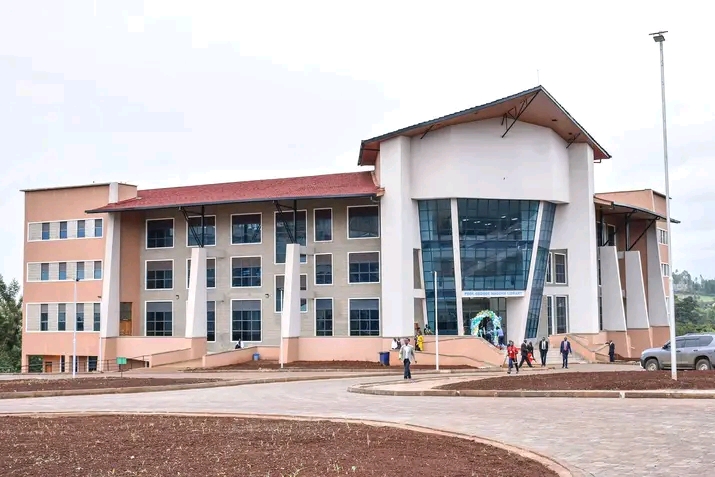
Welcome to University of Embu Digital Repository

This digital repository is a central hub that enables the University to:

  • Preserve and sharing the University's scholarly works.
  • Open up this content to local and global audiences, thanks to the OAI-PMH interface and Google Scholar optimizations
  • Showcases theses, dissertations, research papers, and publications.
  • Promotes open access to research and academic knowledge.
  • Ensures long-term digital preservation of academic content.
  • Supports the University's mission of research, innovation, and learning.
Important Links
Photo by @embuni

Recent Submissions

  • Item type: Item ,
    The Relationship Between Teachers' Planning and Content Delivery Using the Five-Stage Lesson Plan Structure: An Analysis of Age, Gender, Experience and Academic Qualifications in Kenya
    (Wiley, 2025-01-17) Victor Okoth Saoke; Zachary N. Ndwiga; Pauline W. Githaiga; Ciriaka Muriithi Gitonga; Kaberia Isaac Kubai; Christine Mueni Nzomo; Brian Munyao Mulonz; Dickens Okach Ngicho
    Effective instruction is vital for quality education in Kenya, with learners' success mainly dependent on structured methods like the five-stage lesson plan (5-SLP). Nonetheless, the effectiveness of instruction may differ depending on the demographic and professional attributes of the teachers. Although the value of planning for content delivery is well acknowledged, there is limited information on how teachers' characteristics (age, gender, experience and academic qualification) influence their planning and content delivery. Thus, this study examined the relationship between teachers' planning and content delivery through the 5SLP, focusing on their characteristics. A sample of 226 CRE teachers was analysed using an observation checklist and a semistructured questionnaire. The impact of gender, age, experience and academic qualification on teachers' planning and content delivery was investigated in the study using multivariate analysis of variance (MANOVA) and tests of between-subjects effects. Results indicated that age significantly affects both planning and content delivery (p=0.003, p=0.002, p=0.000), while gender, experience and educational qualifications did not show a substantial impact. Nevertheless, significant combined effects were observed between age and gender (p=0.010), gender and experience (p=0.045), age and experience (p=0.004) and age and academic qualification (p=0.016). Furthermore, tests of between-subjects effects indicated significant interactions among age, academic qualifications and experience (p=0.039, p=0.016, p=0.004) affecting content delivery. The study findings recommended a policy on the need for customised training programmes that consider these complex interactions to enhance instructional effectiveness. Generally, the study contributes to understanding how demographics influence educational practices, offering valuable insights for improving teacher preparation and professional development.
  • Item type: Item ,
    FEASIBILITY OF BASMATI HYBRID SEED PRODUCTI ON IN KENYA USING HIGH-TEMPERATURE–INDUCED EGMS (2-LINE SYSTEM)
    (African Scholarly Science Communications Trust, 2026-07-11)
    The need to increase rice yield has prompted breeders to adopt hybrid rice seed technology. The main challenge has been finding a female parent that is completely male-sterile so it can be pollinated by a pollen donor. Basmati rice lines are difficult to cross with other lines, limiting the use of their hybrids for yield improvement. The objective of this study was to cross Environment-Sensitive Genic Male Sterile (EGMS) with Basmati to produce hybrid Basmati rice seeds to improve rice yield in Kenya. Photoperiod-sensitive genic male-sterile rice lines IR-73827-23-76-15-7 S and IR-75589-31-27-8-33-2S, and a thermosensitive genic male-sterile line, IR77271-42-25-4-36S, known as P1, P2 and T1, respectively, were obtained from the International Rice Research Institute. These lines were grown under greenhouse (GH) conditions, where temperatures exceeded 34°C to induce complete male sterility. Results showed that under high GH temperatures, both PGMS and TGMS lines had over 89.2±1.8ef pollen sterility, which positively corresponded with over 98.9±0.3d spikelet sterility, whereas Basmati (370 and 217) had as low as 85.8±2e pollen sterility and 69.5±1.1c spikelet sterility, particularly for Basmati217. The best hybrid seed yield was from the cross between Basmati217 and T1(V3), with an average of 39.12%, compared to the control lines (unpollinated), which had 0% seed production, indicating the potential for local Basmati seed production. When tested under GH growth conditions, hybrid lines P1B217 and P2B217 had the highest filled spikelet of 68.5±1.2e and 69.5±1.4e, compared to Basmati370 and 217, which had 37.1±1.4b and 34.3±1.3b, and EGMS P1 and T, which had filled spikelets of 0.7±0.3a and 1.7±0.4a, respectively. This indicates the feasibility of increasing Basmati yield in Kenya using hybrid seed technology (EGMS method) with hybrid seeds free of contamination from self-bred seeds. Additionally, Basmati370 appears to exhibit better heterosis than Basmati217 for most strains studied. In conclusion, the EGMS method should be enhanced to produce Basmati hybrid rice seeds to increase yield and food security.
  • Item type: Item ,
    Enhancing household food security through the secondary school agriculture student: the stakeholders’ perceptions in Kenya
    (2026-02-19) Njura, Hellen Joseph; Kubai, Isaac
    This study investigates stakeholders’ perceptions of the role of secondary school agriculture students in enhancing household food security. Despite extensive research on agricultural education and skills development, limited studies have explored how stakeholders perceive students’ specific roles as learners, innovators, trainers, informants and implementers of food security policy. Using descriptive and correlational designs, data were collected from 376 students, 111 agriculture teachers and 323 parents. Findings show that agriculture students play a significant role in promoting food security through learning, innovation and policy engagement yet, their participation is hindered by the absence of clear policy guidelines. Addressing this gap, the study proposes integrating practical food security initiatives into the secondary agriculture curriculum through experiential learning such as school gardens and community projects. It urges education policymakers, including KICD and the Ministry of Education to institutionalize student participation in food security initiatives, aligning school agriculture with national policies and strengthening cross-sector collaboration with the Ministry of Agriculture.
  • Item type: Item ,
    Governance Dynamics of Community Forest Associations in Kenya
    (UoEm, 2026-03-27) Wang’ombe, Esther; Mugwe, Jayne; Mugendi, Daniel; Muriuki, Salome Salome
    Participatory forest management (PFM) involves empowering local communities to manage forest resources sustainably. However, the forest cover in Kenya has been decreasing, despite the presence of PFM. This paper examines the integrated governance of forest resources by Community Forest Associations (CFAs) under participatory forest management in the Mt. Kenya Forest area, using the case study approach. The study used a mixed-methods approach, collecting both quantitative and qualitative data. The target population consisted of households within a 5 km radius of the forest. The sample sizes were 114 and 149 from the Hombe and Meru sites, respectively. Data collection included CFA recruitment processes, governance structures, challenges, and mechanisms of strengthening CFAs. Quantitative data were analysed using descriptive statistical techniques in the Statistical Package for the Social Sciences. Quantitative and qualitative data were analysed using a thematic approach to identify themes and patterns. Findings indicate that while financial contributions and adherence to rules are essential for CFA membership, social attributes and community engagement also play a role. The recruitment process for community members into the CFA was structured. One of the greatest impacts of PFM was the empowerment of communities through the establishment of Community Forest Associations to manage and conserve forest resources. However, the governance structures faced some challenges due to a lack of decentralised power from the government. To make effective participation of the people on a sustained basis, the motivation of CFAs is required. Outside intervention may be necessary to resolve problems within the CFAs and assist in strengthening the CFA governance structure, making it more effective.
  • Item type: Item ,
    Gender roles and constraints in enhancing hybrid chicken production for food security in lower Eastern Kenya
    (University of Embu, 2025-03-03) Musyoka John K.; Nyarindo Wilckyster N.; Robyn Alders; Isaboke Hezron N.
    The adoption of hybrid chicken production as a source of income and food security among smallholder farmers has recently taken significant global attention. However, the effect of adoption of hybrid chicken across different genders on household food expenditure and food security remains unknown. This study employed propensity score matching (PSM) and endogenous switching regression (ESR) models to analyze the effect of adoption of hybrid chicken on smallholder households’ consumption expenditure and food security in Machakos County. The PSM and ESR models were estimated on a sample of 582 households selected using multistage stratified random sampling method. The descriptive results indicated that adopters of hybrid chicken spent on average KES 1296 compared to the non-adopters who spent KES 1400 on food consumption per month. Furthermore, the adopters of hybrid chicken were more food secure compared to the non-adopters. About 74% of female were also likely to experience chronic food insecurity compared to their male counterparts. The econometric results indicated that farm location, access to credit, access to market, access to feeds, group membership and cost of feeds significantly influ enced the adoption of the hybrid chicken production for both male and female decision makers. The average treatment effect results showed that non-adopters spent higher costs on food consumption. Moreover, half of the adopters of hybrid chicken were food secure compared to the non-adopters. The treatment effects of adopting hybrid chicken on house hold food consumption and food security were positive suggesting that adopters bene f ited more compared to the non-adopters. To boost food security, this study recommends the National and County governments to develop a facilitating policy environment which supports chicken production systems that are socially, environmentally and economically sustainable while enhancing appropriate technical and extension support to enable cost effective chicken production, marketing, and disease control